Categories
ON-SITE GAS GENERATION

WHY INDUSTRIAL GAS USERS SHOULD RETHINK RENTAL CYLINDER SUPPLY: THE CASE FOR ON-SITE NITROGEN & OXYGEN GAS GENERATION

Across industries—from food packaging and laser cutting to hospitals, labs, 3D printing, power plants, aquaculture, and beyond—nitrogen or oxygen gas is often the invisible backbone of operations. Traditionally, many facilities meet their gas needs through high-pressure cylinders or bulk cylinder manifolds. While this model has worked for decades, it’s far from efficient, and it may be costing your operation far more than necessary. At Canada Gas Solutions Inc.(CGSI), we help companies understand their gas consumption patterns and transition to on-site nitrogen or oxygen gas generation systems that deliver long-term cost savings, operational efficiency, and sustainability.

THE REALITY OF INDUSTRIAL GAS CYLINDERS

Industrial steel gas cylinders come in a wide range of sizes and pressure rating. The most common cylinder size in industrial settings has a water volume capacity of 49 litres and a working pressure of 150 barg (cylinder volumes & pressure ratings can vary manufacturer to manufacturer). These cylinders typically contain around 7–7.3 cubic meters (247–257 cubic feet) of gas.

When these cylinders are manifolded together—often in groups of 4, 8, 16 or more—they form what’s known as a bulk pack, with 16 cylinders delivering up to approximately 4000 cubic feet of gas at full 150 barg pressure. But this is where inefficiencies start to add up.

Hidden Wastage: Pressure Matters

If your process requires a minimum pressure of, say, 250 psig, you can only use the bulk pack until it drops to that level. The remaining gas—often around 30 cubic feet per cylinder—becomes unusable unless you’re charged based on actual usage which is vary rare. The higher your required process pressure, the greater the wastage.

UNDERSTANDING YOUR TRUE GAS NEEDS

Say you’re using one bulk pack (16 cylinders) every 8 hours—that’s approx. 500 cubic feet per hour (cfh). While this gives you a rough idea of average usage per hour but average flow rates don’t tell the whole story.

To design the right on-site gas generation system, it’s essential to understand:

  • Peak Flow Rate
  • Duration of Peal Flow Rate

Accurate digital flowmeters can help capture these metrics when installed with a data logging system. Once you know your true process gas needs, we can start designing an on-site gas generation system that replaces your rental bulk packs or cylinders altogether.

TWO APPROACHES TO REPLACING RENTAL BULK PACKS

Depending on your application and daily routine, there are two primary system configurations that can replace rental bulk pack cylinders.

1. Continuous Flow & Pressure System

Ideal when your process needs are at a steady flow of 500 cfh at 250 psig.

Main System Components:

  • Screw Air Compressor (air- or water-cooled)
  • Refrigerated or Desiccant Air Dryer
  • Dry Air Receiver Tank
  • Gas Generator (PSA, VPSA, or Membrane)
  • Low-Pressure Gas Storage Tank
  • Gas Booster Compressor
  • High-Pressure Gas Storage Tank

2. Bulk Pack Charging System

Idea when gas flowrates are not steady. This system runs at night to fill cylinders or manifolds that you own as part of the on-site gas generation system for use during daytime operations.

Main System Components:

  • Screw Air Compressor (air- or water-cooled)
  • Refrigerated or Desiccant Air Dryer
  • Dry Air Receiver Tank
  • Gas Generator (PSA, VPSA, or Membrane)
  • Low-Pressure Gas Storage Tank
  • Gas Booster Compressor sized for desired fill rate
  • Cylinder Manifold (Sized based on required gas storage capacityto meet your process gas flow needs)
WHY MAKE THE SWITCH?
  • Cost Savings: Most companies recoup the cost of their system in 6–24 months.
  • No More Deliveries: Eliminate dependence on scheduled deliveries and cylinder handling.
  • Reduced Wastage: On-site systems deliver gas at the pressure you need—without leftover gas.
  • Operational Uptime: Say goodbye to downtime due to late deliveries or empty cylinders.
  • Sustainability: Reduce your carbon footprint by eliminating transport-related emissions.
CANADA GAS SOLUTIONS: YOUR PARTNER IN THE TRANSITION

We provide turnkey solutions tailored to your needs. Whether you want a complete system or just a component—like an on-site gas generator, gas booster compressor, high pressure cylinder manifold, low-pressure & high-pressure gas storage tanks—we can supply any piece of the puzzle.

Already have an on-site nitrogen or oxygen system? We can help upgrade your low-pressure setup to a high-pressure cylinder charging system to meet new or growing gas demand—without replacing your existing investment. Consult your options with CGSI.

If you’re still renting cylinders or coordinating bulk pack deliveries, it’s time to ask: How much is this costing me? Connect with Canada Gas Solutions today for a consultation. We’ll evaluate your current gas usage, show you how to transition, and help you build a system that fits both your technical needs and your budget.

Enquire Now
    Categories
    ON-SITE GAS GENERATION

    WHAT MAKES CANADA GAS SOLUTIONS’ ONSITE NITROGEN & OXYGEN GENERATING SYSTEMS A 24/7 POWERHOUSE ACROSS INDUSTRIES

    In today’s demanding industrial landscape, reliability isn’t optional—it’s essential. Whether it’s food packaging, laser cutting, aquaculture, or electronics manufacturing, uninterrupted gas supply can mean the difference between optimized performance and costly downtime. At Canada Gas Solutions, we engineer our onsite Nitrogen and Oxygen gas generating systems to operate 24/7. At the core of this performance lies a critical element: our process valves.

    ENGINEERED FOR PERFORMANCE: THE VALVE ADVANTAGE

    Each of our systems requires rapid valve cycling—as often as every 60 seconds or faster, depending on the application. That’s a demanding duty cycle, and it’s why we’ve made the careful selection of valves a priority in our system design.

    We use high-performance stainless steel angle piston valves, sourced from world-renowned manufacturers, chosen for their:

    • Fastest response time in class—essential for tight process control
    • Robust stainless-steel construction (MOC)
    • Exceptional reliability in high-frequency switching environments
    • Ease of maintenance with minimal downtime
    • Lowest cost of ownership & maintenance over time
    • Design life of 10+ years in continuous duty operation

    These valves are not just parts—they’re the foundation of a system you can count on day and night, year after year.

    QUALITY IN EVERY DETAIL

    Canada Gas Solutions takes pride in meticulous subcomponent selection. Our systems are built to perform for decades, and that starts with using only premium-grade materials. From valves to sensors and PLCs, each part is selected to meet the demands of tough industrial applications. When you build systems for mission-critical industries, you don’t compromise—and neither do we.

    BUILT FOR THE LONG HAUL

    With Canada Gas Solutions, you’re not just buying a gas generator. You’re investing in a field-proven, custom-engineered system designed to deliver uninterrupted performance, minimal maintenance, and long-term dependability. When the pressure’s on and uptime matters, our systems are ready—valve by valve, system by system.

    If you’re planning an onsite Nitrogen or Oxygen gas generating system for your plant or a project, contact Canada Gas Solutions to feel the difference.

    Enquire Now

      Categories
      ON-SITE GAS GENERATION

      FUTURE READY GAS GENERATION: THE FIELD EXPANDABLE SYSTEM (FES) ADVANTAGE BY CANADA GAS SOLUTIONS

      In the evolving landscape of industrial manufacturing, one thing is certain—your operation’s gas demand won’t stay the same forever. Whether you’re in food packaging, aquaculture, electronics, chemical processing, or pharmaceuticals, increased production capacity often brings an increase in nitrogen or oxygen gas requirements. That’s why Canada Gas Solutions has engineered the Field Expandable System (FES) — a scalable and future-ready solution for onsite PSA nitrogen and oxygen gas generation.

      WHAT IS THE FIELD EXPANDABLE SYSTEM (FES)?

      The FES is a unique, PSA gas generator design that allows customers to expand gas output capacity by simply adding additional adsorber towers to the existing system frame—without having to purchase a completely new standalone system. This innovation is aimed at supporting businesses that anticipate growth but want to avoid redundant investments and system overhauls in the future.

      HOW FES SYSTEMS COMPARES TO CONVENTIONAL MODULAR SYSTEMS

      Most gas generation systems on the market today are limited in scale or will provide limited scalability. By contrast, Canada Gas Solutions’ FES design allows your system to grow with your operations. Whether you need to double, triple, or even quadruple your system’s flowrate, you can do so seamlessly—by simply integrating new adsorber towers into your existing system frame.

      REAL-WORLD COST COMPARISON: FES VS. CONVENTIONAL SYSTEMS

      Let’s break it down with an example:

      • A twin tower psa nitrogen generator system might cost approximately $47,000 CAD for a medium range flowrate application/project.
      • If your production needs to double in two years, buying another unit would bring your total investment to around $94,000 CAD.

      Now consider a Field Expandable System:

      • The initial cost of an FES unit capable of 2x expansion may be slightly higher—around $50,000 CAD.
      • When the time comes to expand, you only need to invest $28,000 CAD to add another set of adsorber towers, make necessary piping modifications, reconfigure the control system, and commission the updated system.

                   Total cost with FES: $78,000 CAD
                   Compared to conventional: $94,000 CAD


      Not to mention lower installation overhead and zero duplication of controllers & controls, valves, piping or system frames. Note : This is an example for explanation only. Actual savings vary based on system size and application requirements.

      DESIGNED FOR OPERATIONAL FREEDOM AND LOWER MAINTENANCE COSTS

      Another key advantage of Canada Gas Solutions’ FES design is that it’s built entirely using non-proprietary components. This gives end users the freedom to maintain and service the system themselves, without being tied to a single-source vendor. Parts are widely available, and maintenance can be handled by in-house teams or local service providers—helping to keep long-term maintenance costs as low as possible.

      This level of independence and flexibility is rarely found in proprietary modular systems, which often lock customers into expensive service contracts and limited parts availability.

      SCALABLE COMPRESSION & ENERGY EFFICIENCY

      Designing for future expansion also means planning compressor capacity wisely. FES system performs best when paired with:

      • A compressor system with turn-down/turn-up capability to optimize energy usage during varying demand, or
      • A scalable approach, where additional compressors can be added in the future as more adsorber towers are integrated.

      This ensures the entire system grows efficiently and cost-effectively with your production requirements.

      A SMARTER LONG-TERM INVESTMENT

      FES systems are designed with the end user’s growth, flexibility, and cost-efficiency in mind. By investing in a scalable system from day one, you avoid unnecessary duplication, reduce capital, and eliminate the logistical headaches of installing entirely new PSA systems down the line.

      Whether you’re planning an expansion in 6 months or 3 years, the Field Expandable System by Canada Gas Solutions gives you the flexibility and confidence to grow without overcommitting resources too early.

      Reach out to Canada Gas Solutions to learn more about our Field Expandable System designs for onsite PSA nitrogen and oxygen generation. Let us show you how smart planning today can save you real money, time, and effort tomorrow.

      Enquire Now

        Categories
        ON-SITE GAS GENERATION

        A BUYER’S GUIDE: WHAT TO EVALUATE BEFORE INVESTING IN AN ON-SITE NITROGEN OR OXYGEN GAS GENERATING SYSTEM

        Purchasing an on-site gas generating system—whether for nitrogen or oxygen — is a strategic investment that can reduce reliance on delivered gases, cut long-term costs, and improve operational control. However, choosing the right system involves more than comparing prices. Here’s a detailed look at the critical factors you should evaluate to make an informed decision.

        IS THE SYSTEM DESIGNED TO MEET YOUR PROCESS REQUIREMENTS AND DOES IT MEET YOUR CURRENT & FUTURE NEEDS?

        This is the most important question. The system must reliably deliver the required gas purity, flow rate (SCFM or Nm3/hr), pressure (PSIG or Barg) and dewpoint (Deg C) that your process demands today, while also having the flexibility or capacity to handle any foreseeable increases in demand. Always review detailed technical proposals, including data sheets and performance guarantees, to ensure the system aligns with both your immediate process needs and your future growth plans.

        CAN THE SYSTEM FOOTPRINT BE ACCOMMODATED WITHIN YOUR FACILITY?

        Space is often a constraint, especially in existing plants. Check:

        • The physical dimensions of the system.
        • Required clearances for maintenance access.

        A well-designed system proposal should come with a detailed system P & ID and layout drawing that allows you to visualize integration into your existing facility or help you plan for external infrastructure if required.

        WHAT IS THE COST TO BUY THE SYSTEM OUTRIGHT, THE ASSOCIATED SYSTEM ERECTION & INSTALLATION COST, ELECTRICAL SCOPE, INSPECTION REQUIREMENTS IF ANY & COMISSIONING COST?

        Look beyond just the base price of the gas generator. A complete on-site system investment should include:

        • The outright purchase cost of the gas generator along with required compressor, dryer, filtration, and storage tanks.
        • System erection & installation costs, including structural work if any, mechanical piping from onsite gas generation system to point of use.
        • Electrical scope, such as power distribution upgrades, cabling, and integration with existing control systems.
        • Any mechanical or electrical inspection requirements that may be mandated by local codes.
        • Commissioning costs, covering final system checks, performance validation, and training for your operations & maintenance team.
        HOW POWER EFFICIENT IS THE SYSTEM & SYSTEM’S RUNNING COST?

        The largest operating cost over the system’s lifetime is typically power.

        Review:

        • Power consumption of the system in kWh(kilowatt-hour). Calculate system running cost based on hours of operation per day and based on energy rates in your area or based on your contract with your energy supplier.

        Example running cost calculation:

        A 40 HP (30 kW) compressor running 8 hours/day consumes 240 kWh/day.
        At $0.12/kWh, that’s $29/day or ~$8,500/year just for electricity.

        • Explore energy-saving features like variable speed drives on air compressors, purge economizers on dryers, or automatic shutdown modes when there is no gas demand for the process.
        WHAT IS THE YEARLY MAINTENANCE COST?

        Ask for an estimated annual maintenance budget, covering:

        • Filter element replacements & any other system consumables.
        • Lubricants and service kits for air compressors.

        A good supplier should give you at least a 2-year maintenance spare cost estimate upfront.

        HOW EASY IS THE SYSTEM TO MAINTAIN?
        • Can your internal plant maintenance team handle routine services (filter element changes & replacement of system consumables)?
        • Does it require specialized technicians from the manufacturer for even minor tasks?

        Look for systems with simplified designs and clear maintenance instructions.

        ARE SPARE PARTS NON-PROPRIETARY AND READILY AVAILABLE?

        This is critical for long-term independence and avoiding downtime:

        • Does the system use standard off-the-shelf filters, valves, and controls, or are you locked into buying proprietary parts?
        • How quickly can common wear parts be shipped to you?
        ASK FOR A LIST OF RECOMMENDED CRITICAL SPARE PARTS for the system

        A reliable supplier should provide you with a recommended list of critical spare parts to keep on hand. This helps ensure that in case of unexpected failures or routine wear, you can minimize downtime.

        • This list typically includes valves, sensors, and control components most subject to wear.
        • Knowing upfront what parts are recommended—and their costs—also helps you plan your spare parts inventory and maintenance budget.

        It’s a simple but crucial step to keep your system running reliably and reduce the risk of unplanned shutdowns.

        Choosing an on-site gas generating system is more than a product purchase—it’s an operational partnership. By carefully assessing how well the system fits your process specs, space, operating costs, maintenance needs, and long-term support, you’ll ensure a reliable and cost-effective supply of gas for years to come. If you’re planning an on-site gas generation project and want a tailored assessment, reach out to us at Canada Gas Solutions Inc. We specialize in designing turnkey nitrogen, oxygen, and hydrogen systems, ensuring they’re perfectly matched to your facility and process.

        Enquire Now

          Categories
          MANUFACTURING

          WHY PSA ADSORBER VESSEL DESIGN MATTERS FOR ON-SITE NITROGEN & OXYGEN GENERATION — AND HOW CANADA GAS SOLUTIONS ENSURES COMPLIANCE & LONG-TERM PERFORMANCE

          When it comes to onsite nitrogen and oxygen gas generation systems, the heart of the system lies in the Pressure Swing Adsorption (PSA) technology — and at the core of PSA is the adsorber vessel. Designing these vessels is not just an engineering task; it is a critical responsibility that directly impacts the reliability, safety, and longevity of the entire system.

          WHY CARBON STEEL IS THE MATERIAL OF CHOICE

          For PSA systems, adsorber vessels are most commonly fabricated from high-quality carbon steel. This is due to a combination of mechanical, economic, and operational reasons:

          • Strength & Pressure Handling: Carbon steel offers excellent tensile strength, making it ideal to handle the frequent pressure fluctuations inherent in PSA processes.
          • Fabrication Flexibility: It allows precise welding, forming, and machining, ensuring robust construction.
          • Cost Effectiveness: Compared to stainless steel or exotic alloys, carbon steel provides an optimal balance of performance and cost for most nitrogen and oxygen generation applications.
          • Long-Term Durability: When coupled with proper internal linings and external coatings, carbon steel vessels can reliably serve for 20+ years.

          However, material selection alone does not guarantee performance. The design, welding quality, and strict adherence to pressure vessel standards are equally crucial.

          MEETING ASME & CSA CODES — AND PROVINCIAL CRN REQUIREMENTS

          At Canada Gas Solutions Inc., we recognize that adsorber vessels are not ordinary tanks — they are pressure vessels operating under stringent safety regimes. That’s why every PSA adsorber vessel in our systems is:

          -Designed and certified as per ASME Section VIII, Division 1 & CSA B51 pressure vessel codes.These standards govern material selection, wall thickness calculations, nozzle designs, and destructive & non-destructive examination methods to ensure vessel integrity under operating and test pressures.

          -Built exclusively by ASME “U” and CSA certified fabrication shops. This guarantees that every weld, plate, and nozzle meets the highest North American quality standards, verified through detailed documentation and quality control processes. -Registered and compliant with Canadian CRN requirements. Each province and territory in Canada requires a unique CRN (Canadian Registration Number) for pressure vessels.

          WELD QUALITY & 20+ YEAR SERVICE LIFE

          A PSA adsorber vessel undergoes countless pressure cycles — typically switching from high to low pressure several times, amounting to millions of cycles over its life. This makes weld quality and fatigue resistance absolutely critical.

          Our manufacturing partners employ:

          • Certified welders and welding procedures (WPS) tested as per ASME Section IX.
          • 100% radiographic or ultrasonic inspection of critical weld seams upon special request.
          • Hydrostatic testing at 1.3x the design pressure, providing an additional safety margin.

          This meticulous attention to design and manufacturing translates into adsorber vessels capable of 20+ years of continuous operation, ensuring minimal downtime and optimal return on investment for our customers.

          OUR COMMITMENT AT CANADA GAS SOLUTIONS

          When you choose Canada Gas Solutions for your onsite nitrogen or oxygen gas generation systems, you’re not just buying equipment — you’re investing in:

          • ASME & CSA certified pressure vessels, designed for decades of reliable service.
          • Peace of mind with full compliance to all provincial CRN and inspection requirements.
          • Systems engineered to the highest standards, ensuring safety and uninterrupted production.

          If you’re planning a project or looking to upgrade your existing PSA systems, talk to our team to learn more about how we engineer every critical component — starting with the adsorber vessel — for maximum safety, efficiency, and lifespan.

          Enquire Now

            Categories
            NITROGEN

            THE IMPORTANCE OF DEWPOINT IN ON-SITE NITROGEN GAS GENERATION: GETTING THE RIGHT DRYING TECHNOLOGY FOR YOUR PROCESS

            Nitrogen gas generation using PSA (Pressure Swing Adsorption) or Membrane Technology has become the preferred choice for many industries, offering a reliable, on-demand, and cost-effective alternative to bulk liquid or cylinder supplies. However, one often overlooked but critically important parameter in on-site nitrogen gas generation is dewpoint — a direct measure of the dryness of the gas. Dewpoint impacts not only the performance of the nitrogen generator but also the quality and reliability of your downstream processes. Ensuring the right upstream air-drying technology is selected is essential to achieving the required nitrogen dewpoint for your application.

            WHY DEWPOINT MATTERS IN NITROGEN GAS GENERATION

            When generating nitrogen gas on-site via PSA or membrane systems, the dewpoint of the feed compressed air directly affects the purity, stability, and dryness of the nitrogen gas produced. A poor or unstable dewpoint can lead to:

            • Moisture breakthrough in adsorption beds (for PSA systems), reducing nitrogen purity and damaging the adsorbent.
            • Reduced membrane efficiency and increased risk of fouling (for membrane systems).
            • Corrosion or contamination in sensitive downstream equipment or processes.

            For many industrial processes, nitrogen gas dewpoint must be consistently maintained to avoid product defects, compromised quality, or even safety hazards.

            SELECTING THE CORRECT AIR-DRYING TECHNOLOGY: REFRIGERATED VS DESICCANT DRYERS

            Non-critical applications: Refrigerated dryers

            For many general industrial uses — such as nitrogen purging of tanks, inerting, tire filling, or certain packaging lines — a dewpoint of +3 to +5°C achieved by a refrigerated air dryer is sufficient. These systems remove enough moisture to protect the nitrogen generator and meet typical process needs at a lower capital and operational cost.

            Critical applications: Desiccant dryers

            However, processes such additive manufacturing (3D printing), electronics, pharmaceutical production, or specialty chemical processes demand very low dewpoints (e.g., -40°C to -70°C) to ensure ultra-dry nitrogen gas. Here, using a desiccant (twin tower) air dryer upstream of the nitrogen generator becomes essential. It prevents moisture from entering and saturating the nitrogen generator’s adsorption beds or membranes, preserving purity, extending lifespan, and ensuring gas delivered to critical processes is dry enough to meet stringent specifications.

            ARE INBUILT DESICCANT DRYERS IN psa NITROGEN GENERATORS A GOOD IDEA?

            Some nitrogen generator designs incorporate small, integrated desiccant dryers to polish or “final dry” the gas. While this might seem attractive, it often proves to be a design mistake for most industrial users.

            • These inbuilt dryers typically have limited capacity, are difficult to monitor and service, and can add unnecessary complexity to the nitrogen system.
            • They may give a false sense of security, while the actual problem (inadequate upstream air drying) persists.
            • For high flow, high duty-cycle applications, a properly sized external desiccant dryer upstream of the nitrogen generator is more reliable, easier to maintain, and ensures both the nitrogen purity and dewpoint meet specifications consistently.
            HOW CANADA GAS SOLUTIONS HELPS YOU GET IT RIGHT

            At Canada Gas Solutions, we understand that each application has unique nitrogen purity and dewpoint requirements. Whether you’re using nitrogen for food packaging, laser cutting, pharmaceuticals, or oil & gas operations, we:

            -Analyze your process requirements to determine the ideal nitrogen purity, pressure, flow and dewpoint.
            – Engineer the correct upstream drying solution — refrigerated or desiccant — to protect your PSA or membrane nitrogen system.
            – Ensure your delivered nitrogen meets or exceeds specifications, maximizing quality, reliability, and cost savings.
            -Provide field-proven, energy-efficient systems backed by expert service and support.

            Dewpoint is a critical parameter in nitrogen generation that directly affects your gas quality and your process. Choosing the right drying technology upstream of your PSA or membrane nitrogen generator is not optional — it’s essential. Avoid shortcuts like undersized or integrated dryers that often fail in demanding conditions.

            Let Canada Gas Solutions design a turnkey nitrogen generation and drying solution that’s tailored to your project, ensuring you achieve worry-free operation, lower costs, and superior process outcomes.

            Enquire Now

              Categories
              NITROGEN

              WHY TWIN TOWER NITROGEN GAS GENERATORS REMAIN THE MOST PRACTICAL CHOICE FOR INDUSTRY

              When it comes to on-site nitrogen gas generation, the debate between traditional Twin Tower PSA (Pressure Swing Adsorption) systems and newer modular nitrogen generators is becoming increasingly relevant. While the market is seeing a surge in modular systems advertised as the “next big thing,” experienced operators and maintenance teams continue to favor the tried-and-tested twin tower design. Here’s why.

              Simplicity of Design

              Twin tower nitrogen generators use a straightforward PSA process. Two towers filled with Carbon Molecular Sieve (CMS) alternately adsorb and desorb nitrogen and oxygen under controlled pressure. This time-proven approach:

              • Has minimal moving parts.
              • Uses a predictable valve sequence.
              • Operates with standard controls easily understood by plant technicians.

              By contrast, modular systems often incorporate complex multi-chamber designs or proprietary valve blocks that look sleek but complicate what was once a very simple process.

              Ease of Maintenance

              Twin tower nitrogen systems shine when it comes to serviceability:

              Non-proprietary premium components: From valves to instruments to PLCs, reputable twin tower systems are built with globally recognized brands which are readily available from multiple suppliers.

              Open architecture: Maintenance teams can source spares off-the-shelf without being locked into a single vendor. Service manuals and troubleshooting are straightforward.

              Familiar process: Because PSA twin tower technology has been around for decades, service technicians worldwide are well-trained to maintain them.

              On the flip side, modular nitrogen systems often use proprietary cartridges, special CMS modules, or unique electronic controls. If something breaks, you’re tied to the manufacturer — facing long lead times, expensive spares, and limited service options. Worse, if the manufacturer exits the market, the entire system becomes a stranded asset.

              Handles Large Flowrates Better

              Another crucial advantage: twin tower systems excel in high-flow applications.

              • They can be sized for large nitrogen demands in a single robust system, avoiding the inefficiencies of running multiple smaller units.
              • Modular systems struggle here. To meet higher flows, you must combine multiple modular units, which increases complexity, footprint, maintenance needs — and costs.
              • This means twin tower systems keep overall system costs lower, both in capital and in long-term operation, when compared to “stacking” several modular systems together.
              Reliability & Longevity

              Twin tower PSA systems are designed for continuous duty operation for over 20 years, with only periodic CMS replacement and regular valve servicing. Their robust steel pressure vessels, proven adsorption cycles, and industrial design mean fewer surprises and longer equipment life.

              Sustainability & Eco-friendliness
              • PSA systems recover nitrogen efficiently, minimizing compressed air waste.
              • Long service life means fewer systems replaced over time, reducing industrial waste.
              • Easy access to standard replacement parts means no scrapping of entire system due to unavailability of spares.

              In contrast, proprietary modular systems often require complete module replacements rather than servicing individual components, increasing environmental impact.

              Field Expandability – Not Just for Modular Systems

              A common misconception is that only modular nitrogen systems offer capacity scalability. In reality, twin tower PSA systems are also easily expandable in the field. Additional twin towers can be integrated with your existing setup to increase nitrogen capacity as your plant grows — without redesigning your entire system or getting locked into proprietary add-ons.

              Contact Canada Gas Solutions to learn how we can design and install field-expandable twin tower nitrogen systems tailored to your plant’s future needs.

              Safety & Convenience

              Twin tower PSA systems have well-documented safety records. They:

              • Are designed with standard safety relief valves and controls that are easily inspected.
              • Can be installed by local contractors without needing specialized proprietary certifications.
              Installation Made Easy

              These systems arrive largely pre-assembled and skid-mounted. Piping, wiring, and integration into existing compressed air systems is straightforward, making them ideal for retrofit or greenfield projects.

              The Trap of Proprietary Modular Designs

              Many companies promoting modular nitrogen systems emphasize compactness and “next-gen” technology. But these benefits often come at a cost:

              Locked into single-source support: Only the manufacturer or its agents can supply critical spare parts. Prices and lead times can be high, with little leverage.

              Proprietary control software: Even minor PLC changes or troubleshooting may require OEM technicians.

              No local stock: If a module fails, you can’t simply buy a new valve or sensor off the shelf.

              And when your nitrogen demands grow, the modular approach forces you to keep adding more proprietary units — stacking costs, footprint, and maintenance complexity — rather than scaling up a robust, unified system.

              For businesses that value reliability, ease of maintenance, long-term sustainability, operational independence, and cost-effective solutions, twin tower PSA nitrogen generators remain the clear choice. They are:

              Simple by design — fewer points of failure.
              Easy to maintain — no proprietary parts traps.
              Ideal for large flowrates — avoiding costly multi-unit modular setups.
              Sustainable & eco-friendly — built to last decades.
              Safe & convenient — using familiar technology trusted worldwide.
              Field expandable — ready to grow with your plant.

              Before jumping onto the modular hype train, it’s wise to consider the true costs of ownership, maintenance, and scalability over the life of the equipment. The proven twin tower PSA nitrogen system continues to deliver unmatched value for industries that simply can’t afford downtime.

              Contact Canada Gas Solutions to learn more about robust, twin tower & field-expandable nitrogen systems built with premium, non-proprietary components that keep you in control.

              Enquire Now

                Categories
                NITROGEN

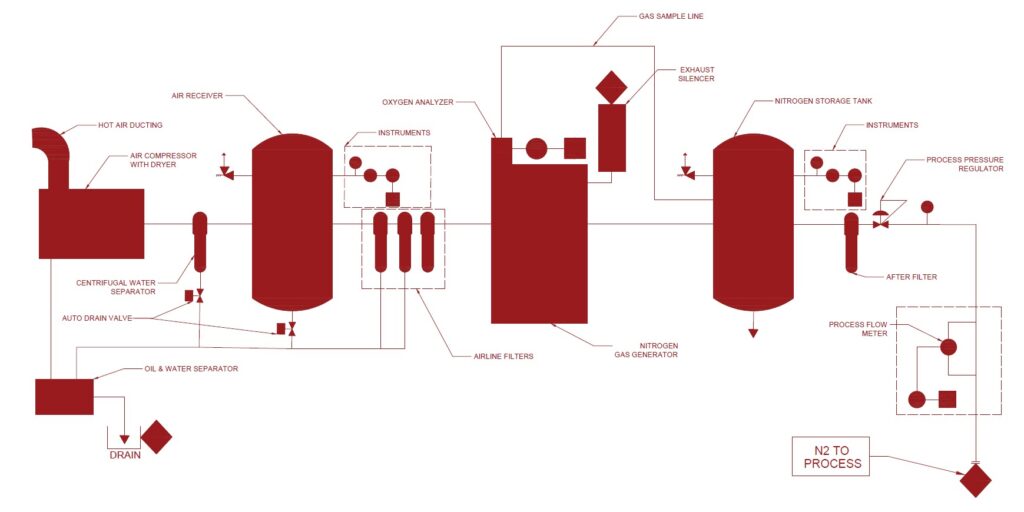
                UNDERSTANDING BUILDING BLOCKS OF A NITROGEN GAS GENERATING SYSTEM

                Nitrogen gas generating systems are indispensable for industries ranging from food packaging and electronics manufacturing to chemical processing and aerospace. These systems offer a cost-effective, sustainable, and reliable source of high-purity nitrogen, eliminating the need for frequent cylinder replacements or liquid nitrogen deliveries. To understand their functionality, it is essential to explore the key components that constitute these systems.

                AIR COMPRESSOR: THE STARTING POINT

                The process begins with the air compressor, which draws in ambient air and compresses it to the pressure required for downstream operations. Modern compressors are designed for energy efficiency, and oil-lubricated or oil-free models are preferred based on applications. Ensuring the air compressor’s capacity matches the nitrogen gas generator’s requirements is crucial for optimal performance.

                AIR RECEIVER TANK

                The incoming compressed air from the compressor has some pressure pulsations. To reduce these pulsations, an air receiver is installed before the air is fed to the nitrogen generator. Condensed moisture is drained out through an Auto Drain Valve located at the bottom of the air receiver.

                AIR DRYER: REMOVING MOISTURE

                Compressed air contains moisture, which can adversely affect the system’s performance. Air dryers remove this moisture to ensure the reliability and longevity of the equipment. Refrigerated dryers are suitable for moderate dew point requirements, while desiccant dryers are used for applications needing ultra-dry air.

                Oil and Water Separator: Condensate Treatment

                An oil and water separator is used to treat condensate collected from the compressed air system. This device separates oil from water, ensuring that the discharge complies with environmental regulations. Proper treatment of condensate is essential for maintaining system efficiency and environmental responsibility.

                FILTRATION FOR gas PURITY

                Filtration is vital for removing particulates, oil, and other contaminants from compressed air. Coalescing filters target oil and water aerosols, particulate filters capture fine particles, and carbon filters eliminate hydrocarbon vapors, ensuring the system produces high-quality nitrogen gas.

                NITROGEN GENERATOR: THE CORE COMPONENT

                The nitrogen generator is the heart of the system, where nitrogen is separated from compressed air. Two common technologies are employed:

                • Pressure Swing Adsorption (PSA): Utilizes carbon molecular sieves to adsorb oxygen , leaving behind nitrogen. This method is ideal for high-purity nitrogen gas requirements.
                • Membrane Separation: Uses semi-permeable membranes to diffuse oxygen and water vapor out, producing nitrogen. Membrane systems are compact and suited for low to moderate purity levels.
                NITROGEN RECEIVER TANKS: ENSURING STEADY SUPPLY

                A low pressure nitrogen gas generating systems typically include two receiver tanks:

                • Air Receiver Tank: Buffers fluctuations in demand and ensures consistent airflow to the generator.
                • Nitrogen Receiver Tank: Stores generated nitrogen gas, providing a steady supply to applications.
                ADVANCED CONTROL SYSTEMS

                Modern systems feature control mechanisms to monitor and manage parameters like pressure, flow rate, and purity levels. Programmable Logic Controllers (PLCs) enable automation and remote monitoring, while user-friendly touchscreen interfaces simplify operation.

                PIPING AND VALVES: SEAMLESS INTEGRATION

                High-quality piping and valves are essential for efficient airflow. Using leak-proof fittings and corrosion-resistant materials ensures the system’s durability and effectiveness.

                PRESSURE REGULATION

                A pressure regulator maintains the correct delivery pressure of nitrogen, safeguarding sensitive equipment and ensuring consistent application performance.

                oxygen ANALYZER: ENSURING STANDARDS

                Oxygen analyzers verify the concentration of nitrogen, ensuring it meets required standards for specific industrial applications.

                OPTIONAL ACCESSORIES

                To enhance functionality, systems may include optional accessories such as gas flow meters to monitor nitrogen usage, alarms for low purity or low/high-pressure issues, and remote monitoring systems for real-time data access.

                Nitrogen gas generating systems are sophisticated assemblies of interconnected components designed to deliver high-quality nitrogen efficiently and reliably. Each component plays a pivotal role in the system’s overall functionality, making it essential for businesses to understand these building blocks. By doing so, they can select and maintain a nitrogen generation solution tailored to their unique needs.

                At Canada Gas Solutions, we specialize in providing perfectly designed nitrogen gas generating systems tailored to meet specific customer requirements. With our expertise in selecting and sizing components, we ensure that our systems are efficient, reliable, and optimized for the unique needs of each application. Let us help you achieve a seamless and sustainable nitrogen generation solution.

                Enquire Now

                  Categories
                  NITROGEN OXYGEN

                  WHY ON-SITE GAS GENERATORS ARE A GAME-CHANGER FOR INDUSTRIAL GAS CONSUMERS

                  For industries relying on nitrogen or oxygen in their operations, the traditional way of sourcing these gases often involves renting high-pressure cylinders or liquid nitrogen tanks. While this approach may seem straightforward, it comes with hidden costs, inefficiencies, and logistical challenges that can be avoided by using on-site nitrogen or oxygen gas generators.

                  Here’s why every industrial gas consumer should compare these two options before making a decision and consider the benefits of generating gas on-site.

                  TAILORED TO YOUR REQUIREMENTS:

                  On-site gas generators produce nitrogen or oxygen precisely when and how you need it. This eliminates the risks of over-ordering or running out of gas. Whether you need a small, steady supply or a large volume for a high-demand process, on-site systems can be customized to match your operational needs. In contrast, cylinders or tanks often lock you into predetermined quantities, forcing you to pay for gas you might not use or scramble when supply runs low.

                  SIGNIFICANT COST SAVINGS:

                  Renting gas cylinders or tanks comes with recurring costs such as:

                  • Delivery charges
                  • Cylinder/tank rental fees
                  • Handling and storage expenses

                  With on-site gas generation, these costs disappear. Once installed, an on-site system draws ambient air and generates gas on demand. Many companies report recouping their initial investment in as little as 6–24 months through reduced operational costs. After that, the savings go straight to your bottom line.

                  OPERATIONAL EFFICIENCY:

                  When you rely on third-party suppliers, you’re also dependent on their schedules. Delayed deliveries can disrupt your operations. On-site systems eliminate this dependency, ensuring uninterrupted gas supply whenever you need it.

                  Furthermore, handling high-pressure cylinders or liquid tanks requires special training and safety precautions, adding complexity to your operations. On-site systems simplify the process, reducing the risk of accidents and freeing up your workforce for more productive tasks.

                  ENVIRONMENTALLY FRIENDLY:

                  Switching to on-site gas generators reduces your carbon footprint. By cutting out the need for frequent gas deliveries and the energy-intensive liquefaction process used in tanks, your operations become significantly more sustainable.

                  FUTURE-PROOF INVESTMENT:

                  Industrial processes evolve, and so do gas requirements. On-site generators are scalable, allowing you to increase capacity as your business grows. This flexibility ensures your investment is future-proof and aligned with your long-term goals.

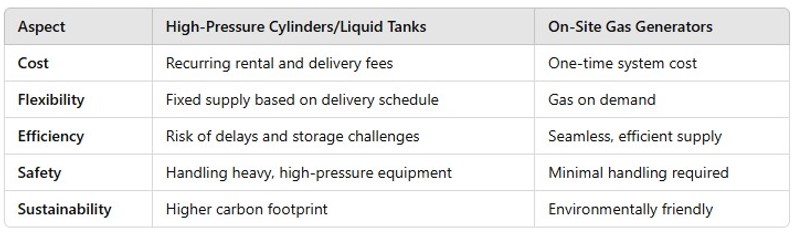
                  WHY MAKE THE SWITCH?

                  Here’s a quick comparison to illustrate the benefits:

                  IS IT RIGHT FOR YOU?

                  On-site gas generators are suitable for a wide range of industries, including:

                  • Food and Beverage
                  • Aquaculture
                  • Hospitals
                  • Waster Water Treatment
                  • Pharmaceuticals
                  • Metal fabrication
                  • Electronics
                  • Automotive

                  If your business uses nitrogen or oxygen regularly, this solution can optimize your operations, improve cost-efficiency, and reduce environmental impact.

                  Investing in an on-site gas generation system is a smart move for companies looking to take control of their industrial gas supply. With the ability to produce gas on demand, scale to meet your needs, and pay off the system cost within 6–24 months, this technology can revolutionize the way you operate.

                  At Canada Gas Solutions Inc., we understand that every business is unique. That’s why we work closely with our customers to fully understand their process requirements, including gas consumption, purity, and pressure needs. Our team designs tailored solutions that seamlessly integrate with your operations, ensuring you get the most efficient and cost-effective system for your business.

                  Stop relying on costly cylinders or tanks. Let Canada Gas Solutions help you explore the benefits of on-site gas generators and take the first step toward a more efficient, cost-effective, and sustainable future for your business. Reach out to us today!

                  Enquire Now

                    Categories
                    NITROGEN

                    THE IMPORTANCE OF NITROGEN GAS IN LASER CUTTING: PRECISION, EFFICIENCY, AND COST SAVINGS

                    Laser cutting has become an essential tool for industries requiring precise, high-quality cuts on metals such as aluminum, mild steel, and stainless steel. Central to this process is the use of high-pressure nitrogen gas, which enhances cut quality by preventing oxidation, enabling smoother edges, and ensuring a polished finish. While traditional nitrogen supply methods like high-pressure cylinders or liquid nitrogen tanks have been the norm, onsite gas generation systems are redefining how manufacturers approach gas supply, offering unmatched efficiency and cost savings.

                    WHY HIGH-PRESSURE NITROGEN GAS IS ESSENTIAL FOR LASER CUTTING :

                    In laser cutting, high-pressure nitrogen gas serves as a shielding agent that displaces oxygen around the cut area. This prevents oxidation, improves cut quality, and maintains the metal’s physical and aesthetic properties.

                    • Aluminum Cutting:
                      Nitrogen ensures a clean, reflective finish by eliminating oxidation, which is critical for applications in automotive, aerospace, and electronics industries.
                    • Mild Steel Cutting:
                      While oxygen is often used for speed, nitrogen is preferred when oxide-free, high-quality edges are required for parts undergoing additional treatments or used in visible applications.
                    • Stainless Steel Cutting:
                      Nitrogen prevents discoloration and preserves the material’s corrosion resistance, making it ideal for decorative and structural uses.
                    ONSITE NITROGEN GENERATORS: THE FUTURE OF GAS SUPPLY

                    HIGH PRESSURE N2 CYLINDERS

                    LIQUID NITROGEN TANK

                    Traditional nitrogen supply methods, such as high-pressure cylinders or liquid nitrogen tanks, come with several challenges: high costs, logistical complexities, and potential supply disruptions. Onsite nitrogen generation systems offer a transformative alternative, producing high-pressure nitrogen gas directly at the point of use.

                    ONSITE NITROGEN GAS GENERATOR

                    Benefits of Onsite Nitrogen Gas Generators:

                    • Unmatched Cost Savings:
                      By eliminating recurring expenses for transport, cylinder handling, and storage, manufacturers can save up to 90% on nitrogen costs.
                    • Customizable Pressure and Purity:
                      Advanced generators provide nitrogen at pressures and purities tailored to specific cutting needs, ensuring optimal performance for aluminum, mild steel, and stainless steel.
                    • Consistent Supply:
                      Onsite systems ensure a continuous flow of nitrogen gas, eliminating the downtime risks associated with delayed cylinder deliveries or empty tanks.
                    • Reduced Environmental Impact:
                      Onsite generation reduces the carbon footprint associated with the transportation and storage of nitrogen, aligning with sustainability goals.
                    CANADA GAS SOLUTIONS: TAILORING NITROGEN SUPPLY FOR YOUR LASER CUTTING NEEDS:

                    At Canada Gas Solutions, we understand the critical role that high-pressure nitrogen gas plays in achieving precise, high-quality cuts in metal fabrication. Our team works closely with manufacturers to assess their laser cutting requirements and recommend nitrogen purity levels to meet specific cut quality standards.

                    Whether you’re cutting aluminum, mild steel, or stainless steel, we provide tailored solutions with onsite nitrogen gas generators that deliver unmatched cost savings, efficiency, and reliability. Say goodbye to the hassles of cylinder management or liquid nitrogen tanks—our systems ensure you have the right purity and pressure of nitrogen gas whenever you need it.

                    Enquire Now