Categories
OXYGEN

WHY TWIN TOWER OXYGEN GAS GENERATORS REMAIN THE MOST PRACTICAL CHOICE FOR INDUSTRY

When it comes to on-site oxygen gas generation, the debate between traditional Twin Tower PSA (Pressure Swing Adsorption) systems and newer modular oxygen generators is gaining attention. While modular systems are marketed as the “next big thing,” plant operators, healthcare facilities, and industrial users continue to trust the time-tested twin tower PSA design. Here’s why.

Simplicity of Design

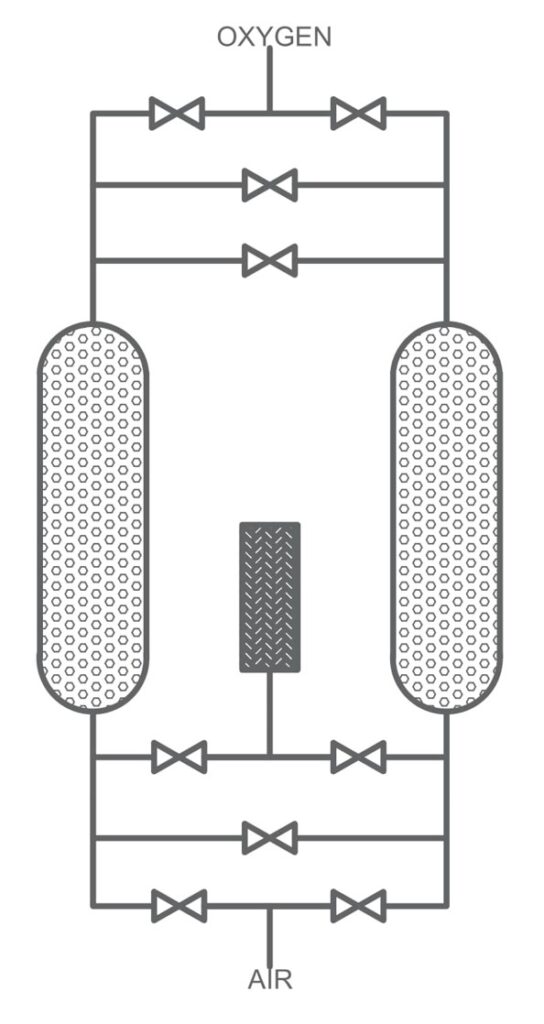
Twin tower oxygen generators use a straightforward PSA process. Two towers filled with Zeolite Molecular Sieve (ZMS) alternately adsorb nitrogen, leaving oxygen-rich gas under controlled pressure. This proven approach:

  • Has minimal moving parts.
  • Uses a predictable valve sequence.
  • Operates with standard controls that are easily understood by plant technicians.

By contrast, modular oxygen systems often use proprietary multi-chamber blocks or special cartridge-based designs. While compact, these designs complicate what was once a very simple process.

Ease of Maintenance

Oxygen PSA twin tower systems excel in serviceability:

  • Non-proprietary components: Valves, instruments, and PLCs are sourced from globally recognized brands and are readily available.
  • Open architecture: Spares can be sourced from multiple suppliers without locking into a single vendor.
  • Well-understood technology: With PSA oxygen generation in service for decades, maintenance teams worldwide are already trained.

Modular oxygen systems, on the other hand, often rely on proprietary cartridges or unique ZMS modules. If something fails, you are tied to the manufacturer, facing high spares cost, long lead times, and limited service options. Worse still, if the OEM exits the market, your oxygen plant risks becoming a stranded asset.

Handles Large Flowrates Better

Twin tower oxygen PSA systems are built for high-flow industrial and medical-grade applications:

  • They can be sized for large oxygen demands within a single robust unit.
  • Modular systems must be “stacked” together to meet higher flows, which increases footprint, complexity, and long-term costs.

This makes twin tower systems far more economical and reliable for hospitals, steel plants, aquaculture farms, and wastewater treatment facilities with significant oxygen requirements.

Reliability & Longevity

Twin tower oxygen PSA systems are engineered for continuous duty operation:

  • Lifespans of 20+ years are common with only periodic ZMS replacement and valve servicing.
  • Heavy-duty steel vessels and proven PSA cycles ensure predictable performance.

In contrast, modular systems often rely on replaceable blocks or cartridges that wear faster — forcing costly replacements instead of simple servicing.

Sustainability & Eco-Friendliness
  • PSA systems recover oxygen efficiently, minimizing compressed air waste.
  • Long service life means fewer replacements and reduced industrial waste.
  • Standard spare parts ensure continued usability, instead of scrapping entire modules.

Modular designs often require complete module replacements, generating more waste and higher lifecycle costs.

Field Expandability – Not Just for Modular Systems

A misconception is that only modular systems are scalable. In reality, twin tower PSA oxygen generators can also be expanded in the field:

  • Additional PSA units can be integrated to grow with your plant.
  • Expansion uses the same standard, non-proprietary components.

This allows cost-effective scaling without being tied into proprietary modular add-ons.

Safety & Convenience

Oxygen generators must meet strict safety standards. Twin tower PSA systems:

  • Use well-documented relief valves, oxygen analyzers, and standard safety controls.
  • Are familiar to local contractors and technicians, avoiding the need for special OEM-only certifications.
Installation Made Easy

Twin tower PSA oxygen systems are skid-mounted and pre-assembled, simplifying installation:

  • Straightforward piping and wiring integration into existing compressed air systems.
  • Suitable for both new facilities and retrofits in industries like medical oxygen supply, metallurgy, or aquaculture.
The Trap of Proprietary Modular Designs

Modular oxygen generators are marketed as compact and “next-gen,” but the hidden costs are clear:

  • Single-source dependence: Critical spares only available from OEM.
  • Locked control systems: Even small PLC updates often require OEM intervention.
  • Scalability trap: To grow capacity, you must keep adding expensive modules, increasing footprint and service complexity.
The Clear Choice: Twin Tower PSA Oxygen Systems

For organizations that value reliability, independence, and long-term cost savings, twin tower PSA oxygen generators remain the superior choice. They are:

  • Simple by design — fewer points of failure.
  • Easy to maintain — no proprietary part lock-ins.
  • Ideal for large oxygen demands — without stacking modules.
  • Sustainable — long service life and minimal waste.
  • Safe & proven — trusted worldwide for decades.
  • Expandable — ready to grow with your oxygen needs.
Partner with Canada Gas Solutions

Before investing in modular “next-gen” hype, consider the true costs of ownership, maintenance, and scalability. The proven Twin Tower PSA oxygen system continues to deliver unmatched value for industries that cannot afford downtime.

Contact Canada Gas Solutions to learn more about robust, twin tower & field-expandable oxygen PSA systems built with premium, non-proprietary components that keep you in control.

Enquire Now

    Categories
    MANUFACTURING

    WHY PSA ADSORBER VESSEL DESIGN MATTERS FOR ON-SITE NITROGEN & OXYGEN GENERATION — AND HOW CANADA GAS SOLUTIONS ENSURES COMPLIANCE & LONG-TERM PERFORMANCE

    When it comes to onsite nitrogen and oxygen gas generation systems, the heart of the system lies in the Pressure Swing Adsorption (PSA) technology — and at the core of PSA is the adsorber vessel. Designing these vessels is not just an engineering task; it is a critical responsibility that directly impacts the reliability, safety, and longevity of the entire system.

    WHY CARBON STEEL IS THE MATERIAL OF CHOICE

    For PSA systems, adsorber vessels are most commonly fabricated from high-quality carbon steel. This is due to a combination of mechanical, economic, and operational reasons:

    • Strength & Pressure Handling: Carbon steel offers excellent tensile strength, making it ideal to handle the frequent pressure fluctuations inherent in PSA processes.
    • Fabrication Flexibility: It allows precise welding, forming, and machining, ensuring robust construction.
    • Cost Effectiveness: Compared to stainless steel or exotic alloys, carbon steel provides an optimal balance of performance and cost for most nitrogen and oxygen generation applications.
    • Long-Term Durability: When coupled with proper internal linings and external coatings, carbon steel vessels can reliably serve for 20+ years.

    However, material selection alone does not guarantee performance. The design, welding quality, and strict adherence to pressure vessel standards are equally crucial.

    MEETING ASME & CSA CODES — AND PROVINCIAL CRN REQUIREMENTS

    At Canada Gas Solutions Inc., we recognize that adsorber vessels are not ordinary tanks — they are pressure vessels operating under stringent safety regimes. That’s why every PSA adsorber vessel in our systems is:

    -Designed and certified as per ASME Section VIII, Division 1 & CSA B51 pressure vessel codes.These standards govern material selection, wall thickness calculations, nozzle designs, and destructive & non-destructive examination methods to ensure vessel integrity under operating and test pressures.

    -Built exclusively by ASME “U” and CSA certified fabrication shops. This guarantees that every weld, plate, and nozzle meets the highest North American quality standards, verified through detailed documentation and quality control processes. -Registered and compliant with Canadian CRN requirements. Each province and territory in Canada requires a unique CRN (Canadian Registration Number) for pressure vessels.

    WELD QUALITY & 20+ YEAR SERVICE LIFE

    A PSA adsorber vessel undergoes countless pressure cycles — typically switching from high to low pressure several times, amounting to millions of cycles over its life. This makes weld quality and fatigue resistance absolutely critical.

    Our manufacturing partners employ:

    • Certified welders and welding procedures (WPS) tested as per ASME Section IX.
    • 100% radiographic or ultrasonic inspection of critical weld seams upon special request.
    • Hydrostatic testing at 1.3x the design pressure, providing an additional safety margin.

    This meticulous attention to design and manufacturing translates into adsorber vessels capable of 20+ years of continuous operation, ensuring minimal downtime and optimal return on investment for our customers.

    OUR COMMITMENT AT CANADA GAS SOLUTIONS

    When you choose Canada Gas Solutions for your onsite nitrogen or oxygen gas generation systems, you’re not just buying equipment — you’re investing in:

    • ASME & CSA certified pressure vessels, designed for decades of reliable service.
    • Peace of mind with full compliance to all provincial CRN and inspection requirements.
    • Systems engineered to the highest standards, ensuring safety and uninterrupted production.

    If you’re planning a project or looking to upgrade your existing PSA systems, talk to our team to learn more about how we engineer every critical component — starting with the adsorber vessel — for maximum safety, efficiency, and lifespan.

    Enquire Now

      Categories
      NITROGEN

      THE IMPORTANCE OF DEWPOINT IN ON-SITE NITROGEN GAS GENERATION: GETTING THE RIGHT DRYING TECHNOLOGY FOR YOUR PROCESS

      Nitrogen gas generation using PSA (Pressure Swing Adsorption) or Membrane Technology has become the preferred choice for many industries, offering a reliable, on-demand, and cost-effective alternative to bulk liquid or cylinder supplies. However, one often overlooked but critically important parameter in on-site nitrogen gas generation is dewpoint — a direct measure of the dryness of the gas. Dewpoint impacts not only the performance of the nitrogen generator but also the quality and reliability of your downstream processes. Ensuring the right upstream air-drying technology is selected is essential to achieving the required nitrogen dewpoint for your application.

      WHY DEWPOINT MATTERS IN NITROGEN GAS GENERATION

      When generating nitrogen gas on-site via PSA or membrane systems, the dewpoint of the feed compressed air directly affects the purity, stability, and dryness of the nitrogen gas produced. A poor or unstable dewpoint can lead to:

      • Moisture breakthrough in adsorption beds (for PSA systems), reducing nitrogen purity and damaging the adsorbent.
      • Reduced membrane efficiency and increased risk of fouling (for membrane systems).
      • Corrosion or contamination in sensitive downstream equipment or processes.

      For many industrial processes, nitrogen gas dewpoint must be consistently maintained to avoid product defects, compromised quality, or even safety hazards.

      SELECTING THE CORRECT AIR-DRYING TECHNOLOGY: REFRIGERATED VS DESICCANT DRYERS

      Non-critical applications: Refrigerated dryers

      For many general industrial uses — such as nitrogen purging of tanks, inerting, tire filling, or certain packaging lines — a dewpoint of +3 to +5°C achieved by a refrigerated air dryer is sufficient. These systems remove enough moisture to protect the nitrogen generator and meet typical process needs at a lower capital and operational cost.

      Critical applications: Desiccant dryers

      However, processes such additive manufacturing (3D printing), electronics, pharmaceutical production, or specialty chemical processes demand very low dewpoints (e.g., -40°C to -70°C) to ensure ultra-dry nitrogen gas. Here, using a desiccant (twin tower) air dryer upstream of the nitrogen generator becomes essential. It prevents moisture from entering and saturating the nitrogen generator’s adsorption beds or membranes, preserving purity, extending lifespan, and ensuring gas delivered to critical processes is dry enough to meet stringent specifications.

      ARE INBUILT DESICCANT DRYERS IN psa NITROGEN GENERATORS A GOOD IDEA?

      Some nitrogen generator designs incorporate small, integrated desiccant dryers to polish or “final dry” the gas. While this might seem attractive, it often proves to be a design mistake for most industrial users.

      • These inbuilt dryers typically have limited capacity, are difficult to monitor and service, and can add unnecessary complexity to the nitrogen system.
      • They may give a false sense of security, while the actual problem (inadequate upstream air drying) persists.
      • For high flow, high duty-cycle applications, a properly sized external desiccant dryer upstream of the nitrogen generator is more reliable, easier to maintain, and ensures both the nitrogen purity and dewpoint meet specifications consistently.
      HOW CANADA GAS SOLUTIONS HELPS YOU GET IT RIGHT

      At Canada Gas Solutions, we understand that each application has unique nitrogen purity and dewpoint requirements. Whether you’re using nitrogen for food packaging, laser cutting, pharmaceuticals, or oil & gas operations, we:

      -Analyze your process requirements to determine the ideal nitrogen purity, pressure, flow and dewpoint.
      – Engineer the correct upstream drying solution — refrigerated or desiccant — to protect your PSA or membrane nitrogen system.
      – Ensure your delivered nitrogen meets or exceeds specifications, maximizing quality, reliability, and cost savings.
      -Provide field-proven, energy-efficient systems backed by expert service and support.

      Dewpoint is a critical parameter in nitrogen generation that directly affects your gas quality and your process. Choosing the right drying technology upstream of your PSA or membrane nitrogen generator is not optional — it’s essential. Avoid shortcuts like undersized or integrated dryers that often fail in demanding conditions.

      Let Canada Gas Solutions design a turnkey nitrogen generation and drying solution that’s tailored to your project, ensuring you achieve worry-free operation, lower costs, and superior process outcomes.

      Enquire Now

        Categories
        NITROGEN

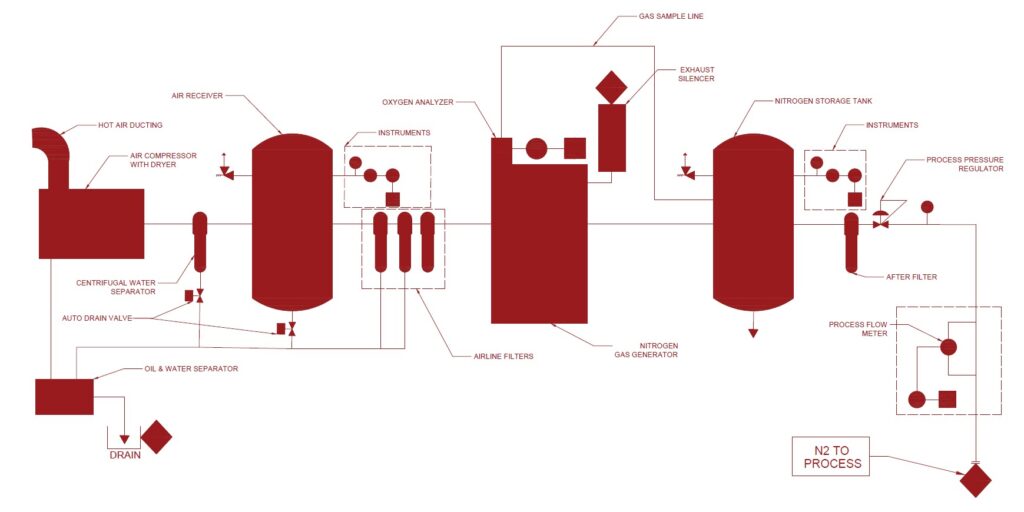
        UNDERSTANDING BUILDING BLOCKS OF A NITROGEN GAS GENERATING SYSTEM

        Nitrogen gas generating systems are indispensable for industries ranging from food packaging and electronics manufacturing to chemical processing and aerospace. These systems offer a cost-effective, sustainable, and reliable source of high-purity nitrogen, eliminating the need for frequent cylinder replacements or liquid nitrogen deliveries. To understand their functionality, it is essential to explore the key components that constitute these systems.

        AIR COMPRESSOR: THE STARTING POINT

        The process begins with the air compressor, which draws in ambient air and compresses it to the pressure required for downstream operations. Modern compressors are designed for energy efficiency, and oil-lubricated or oil-free models are preferred based on applications. Ensuring the air compressor’s capacity matches the nitrogen gas generator’s requirements is crucial for optimal performance.

        AIR RECEIVER TANK

        The incoming compressed air from the compressor has some pressure pulsations. To reduce these pulsations, an air receiver is installed before the air is fed to the nitrogen generator. Condensed moisture is drained out through an Auto Drain Valve located at the bottom of the air receiver.

        AIR DRYER: REMOVING MOISTURE

        Compressed air contains moisture, which can adversely affect the system’s performance. Air dryers remove this moisture to ensure the reliability and longevity of the equipment. Refrigerated dryers are suitable for moderate dew point requirements, while desiccant dryers are used for applications needing ultra-dry air.

        Oil and Water Separator: Condensate Treatment

        An oil and water separator is used to treat condensate collected from the compressed air system. This device separates oil from water, ensuring that the discharge complies with environmental regulations. Proper treatment of condensate is essential for maintaining system efficiency and environmental responsibility.

        FILTRATION FOR gas PURITY

        Filtration is vital for removing particulates, oil, and other contaminants from compressed air. Coalescing filters target oil and water aerosols, particulate filters capture fine particles, and carbon filters eliminate hydrocarbon vapors, ensuring the system produces high-quality nitrogen gas.

        NITROGEN GENERATOR: THE CORE COMPONENT

        The nitrogen generator is the heart of the system, where nitrogen is separated from compressed air. Two common technologies are employed:

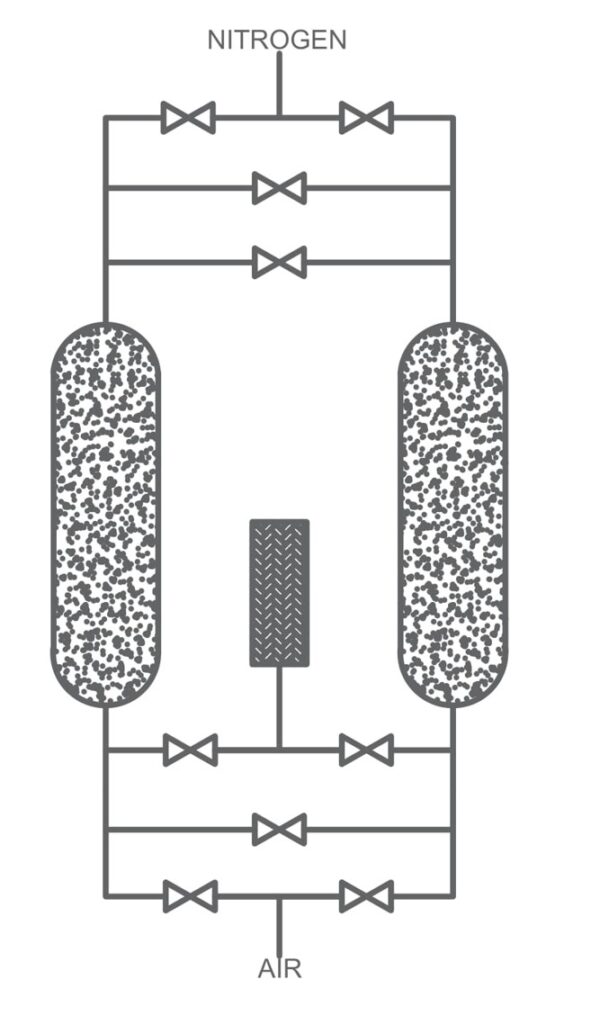
        • Pressure Swing Adsorption (PSA): Utilizes carbon molecular sieves to adsorb oxygen , leaving behind nitrogen. This method is ideal for high-purity nitrogen gas requirements.
        • Membrane Separation: Uses semi-permeable membranes to diffuse oxygen and water vapor out, producing nitrogen. Membrane systems are compact and suited for low to moderate purity levels.
        NITROGEN RECEIVER TANKS: ENSURING STEADY SUPPLY

        A low pressure nitrogen gas generating systems typically include two receiver tanks:

        • Air Receiver Tank: Buffers fluctuations in demand and ensures consistent airflow to the generator.
        • Nitrogen Receiver Tank: Stores generated nitrogen gas, providing a steady supply to applications.
        ADVANCED CONTROL SYSTEMS

        Modern systems feature control mechanisms to monitor and manage parameters like pressure, flow rate, and purity levels. Programmable Logic Controllers (PLCs) enable automation and remote monitoring, while user-friendly touchscreen interfaces simplify operation.

        PIPING AND VALVES: SEAMLESS INTEGRATION

        High-quality piping and valves are essential for efficient airflow. Using leak-proof fittings and corrosion-resistant materials ensures the system’s durability and effectiveness.

        PRESSURE REGULATION

        A pressure regulator maintains the correct delivery pressure of nitrogen, safeguarding sensitive equipment and ensuring consistent application performance.

        oxygen ANALYZER: ENSURING STANDARDS

        Oxygen analyzers verify the concentration of nitrogen, ensuring it meets required standards for specific industrial applications.

        OPTIONAL ACCESSORIES

        To enhance functionality, systems may include optional accessories such as gas flow meters to monitor nitrogen usage, alarms for low purity or low/high-pressure issues, and remote monitoring systems for real-time data access.

        Nitrogen gas generating systems are sophisticated assemblies of interconnected components designed to deliver high-quality nitrogen efficiently and reliably. Each component plays a pivotal role in the system’s overall functionality, making it essential for businesses to understand these building blocks. By doing so, they can select and maintain a nitrogen generation solution tailored to their unique needs.

        At Canada Gas Solutions, we specialize in providing perfectly designed nitrogen gas generating systems tailored to meet specific customer requirements. With our expertise in selecting and sizing components, we ensure that our systems are efficient, reliable, and optimized for the unique needs of each application. Let us help you achieve a seamless and sustainable nitrogen generation solution.

        Enquire Now

          Categories
          NITROGEN OXYGEN

          WHY ON-SITE GAS GENERATORS ARE A GAME-CHANGER FOR INDUSTRIAL GAS CONSUMERS

          For industries relying on nitrogen or oxygen in their operations, the traditional way of sourcing these gases often involves renting high-pressure cylinders or liquid nitrogen tanks. While this approach may seem straightforward, it comes with hidden costs, inefficiencies, and logistical challenges that can be avoided by using on-site nitrogen or oxygen gas generators.

          Here’s why every industrial gas consumer should compare these two options before making a decision and consider the benefits of generating gas on-site.

          TAILORED TO YOUR REQUIREMENTS:

          On-site gas generators produce nitrogen or oxygen precisely when and how you need it. This eliminates the risks of over-ordering or running out of gas. Whether you need a small, steady supply or a large volume for a high-demand process, on-site systems can be customized to match your operational needs. In contrast, cylinders or tanks often lock you into predetermined quantities, forcing you to pay for gas you might not use or scramble when supply runs low.

          SIGNIFICANT COST SAVINGS:

          Renting gas cylinders or tanks comes with recurring costs such as:

          • Delivery charges
          • Cylinder/tank rental fees
          • Handling and storage expenses

          With on-site gas generation, these costs disappear. Once installed, an on-site system draws ambient air and generates gas on demand. Many companies report recouping their initial investment in as little as 6–24 months through reduced operational costs. After that, the savings go straight to your bottom line.

          OPERATIONAL EFFICIENCY:

          When you rely on third-party suppliers, you’re also dependent on their schedules. Delayed deliveries can disrupt your operations. On-site systems eliminate this dependency, ensuring uninterrupted gas supply whenever you need it.

          Furthermore, handling high-pressure cylinders or liquid tanks requires special training and safety precautions, adding complexity to your operations. On-site systems simplify the process, reducing the risk of accidents and freeing up your workforce for more productive tasks.

          ENVIRONMENTALLY FRIENDLY:

          Switching to on-site gas generators reduces your carbon footprint. By cutting out the need for frequent gas deliveries and the energy-intensive liquefaction process used in tanks, your operations become significantly more sustainable.

          FUTURE-PROOF INVESTMENT:

          Industrial processes evolve, and so do gas requirements. On-site generators are scalable, allowing you to increase capacity as your business grows. This flexibility ensures your investment is future-proof and aligned with your long-term goals.

          WHY MAKE THE SWITCH?

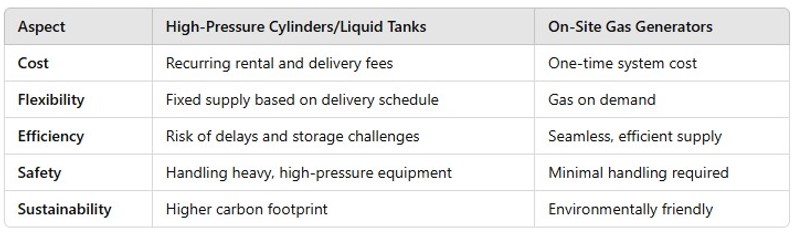
          Here’s a quick comparison to illustrate the benefits:

          IS IT RIGHT FOR YOU?

          On-site gas generators are suitable for a wide range of industries, including:

          • Food and Beverage
          • Aquaculture
          • Hospitals
          • Waster Water Treatment
          • Pharmaceuticals
          • Metal fabrication
          • Electronics
          • Automotive

          If your business uses nitrogen or oxygen regularly, this solution can optimize your operations, improve cost-efficiency, and reduce environmental impact.

          Investing in an on-site gas generation system is a smart move for companies looking to take control of their industrial gas supply. With the ability to produce gas on demand, scale to meet your needs, and pay off the system cost within 6–24 months, this technology can revolutionize the way you operate.

          At Canada Gas Solutions Inc., we understand that every business is unique. That’s why we work closely with our customers to fully understand their process requirements, including gas consumption, purity, and pressure needs. Our team designs tailored solutions that seamlessly integrate with your operations, ensuring you get the most efficient and cost-effective system for your business.

          Stop relying on costly cylinders or tanks. Let Canada Gas Solutions help you explore the benefits of on-site gas generators and take the first step toward a more efficient, cost-effective, and sustainable future for your business. Reach out to us today!

          Enquire Now

            Categories
            NITROGEN OXYGEN

            EARTH’S ATMOSPHERE, COMPOSITION & SEPARATION METHODS FOR NITROGEN & OXYGEN

            The Earth’s atmosphere is a delicate blanket of gases that envelops our planet, providing the necessary conditions for life to thrive. Comprising various gases in different proportions, this atmosphere plays a crucial role in regulating temperature, protecting life from harmful radiation, and sustaining vital processes like photosynthesis. Understanding its composition and the methods for separating its primary constituents, nitrogen and oxygen, is essential for various industrial, scientific, and environmental endeavors.

            Composition of Earth’s Atmosphere:

            Earth’s atmosphere is primarily composed of nitrogen (N2), oxygen (O2), argon (Ar), and traces of other gases such as carbon dioxide (CO2), neon (Ne), helium (He), methane (CH4), and ozone (O3). The most abundant gases are nitrogen and oxygen, which together constitute approximately 99% of the atmosphere’s total volume.

            • Nitrogen (N2): Nitrogen makes up about 78% of the Earth’s atmosphere. It is crucial for various biological processes and is used extensively in industrial applications, such as in the production of ammonia for fertilizers and in the manufacturing of electronics.
            • Oxygen (O2): Oxygen accounts for roughly 21% of the atmosphere. It is vital for respiration in most organisms and is also widely utilized in industrial processes, including metal smelting, combustion, and medical applications.
            • Argon (Ar): Argon constitutes around 0.9% of the atmosphere and is primarily used in welding and as an inert gas in various industrial processes.
            Methods of Separating Nitrogen and Oxygen:

            Fractional Distillation:

            LIQUID NITROGEN/OXYGEN STORAGE EQUIPMENT FOR INDUSTRIAL USE

            Fractional distillation is based on the principle of differences in boiling points of gases. Air is first cooled and compressed to liquify it. Then, the liquid air is allowed to boil slowly. As the temperature increases, gases with lower boiling points, such as nitrogen and oxygen, vaporize first. By collecting these vapors separately and condensing them, nitrogen and oxygen can be obtained in their pure forms. Fractional distillation is a well-established and efficient method for large-scale production of nitrogen and oxygen. Fractional distillation requires significant energy input due to the need for cooling and compressing air. Additionally, it is a capital-intensive process, making it less suitable for small-scale applications.

            Membrane Separation:

            Membrane separation relies on permeation through selective membranes. In this method, air is passed through a membrane that selectively allows certain gases, such as nitrogen, to permeate more readily than others, such as oxygen. By controlling factors like pressure, temperature and membrane material, the desired gases can be separated. Membrane separation is energy-efficient at lower purities and scalable. It can be employed for both large-scale industrial processes and smaller applications. It also offers flexibility in terms of operation and requires less maintenance compared to other methods.

            Pressure Swing Adsorption (PSA):

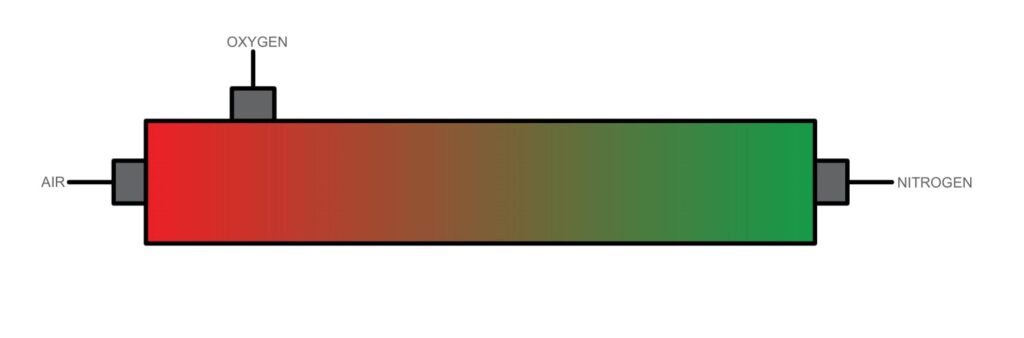
            PSA involves passing air through a bed of adsorbent material, such as carbon molecular or zeolite sieve, at high pressure. The adsorbent selectively adsorbs oxygen or nitrogen while allowing other gas to pass through. After a period, the pressure is reduced, allowing the adsorbed oxygen or nitrogen to desorb and be released. PSA is highly efficient and can produce gases with high purity levels. It is the most suitable technology for on-site gas generation of nitrogen and oxygen and can be automated for 24/7 operation.

            The composition of Earth’s atmosphere, dominated by nitrogen and oxygen, is essential for sustaining life and supporting various industrial processes. Understanding the methods for separating these gases is crucial for applications ranging from medical oxygen supply to industrial gas production. While each separation method has its advantages and limitations, advancements in technology continue to refine these processes, making them more efficient, cost-effective, and environmentally friendly. As we delve deeper into the intricacies of atmospheric science and gas separation techniques, we unlock new possibilities for innovation and sustainable development.

            Enquire Now

              Categories
              NITROGEN

              MAXIMIZING PERFORMANCE AND SAFETY: THE ROLE OF NITROGEN GAS IN AIRCRAFT AND AUTOMOBILE TIRE FILLING

              In Aviation and Automotive industries, safety and performance are paramount. Every component and every decision made can have a significant impact on efficiency, reliability, and safety. One such crucial element often overlooked is tire inflation. While air has been the traditional choice for tire inflation, nitrogen gas has emerged as a superior alternative for aircraft and automobile tires, offering numerous benefits. Moreover, the adoption of onsite nitrogen gas generators presents a compelling case for cost-efficiency and convenience. Let’s delve into the significance of nitrogen gas and the advantages of having your own onsite nitrogen gas generator.

              Nitrogen gas: enhancing performance & safety

              Pressure Stability: Nitrogen molecules are larger than oxygen molecules, reducing the rate at which they permeate through tire walls. This characteristic ensures more stable tire pressure over time, reducing the frequency of tire pressure checks and adjustments. Stable tire pressure is critical for maintaining optimal performance and handling, especially in aircraft where precision and stability are paramount.

              Reduced Oxidation & Corrosion: Nitrogen is an inert gas, meaning it does not react with other substances. Unlike oxygen, which can cause oxidation and corrosion, nitrogen minimizes these risks. In aircraft, where tires are subjected to extreme conditions including high speeds, temperature variations, and exposure to various chemicals on runways, the reduced risk of oxidation and corrosion translates to enhanced tire longevity and safety.

              Temperature Stability: Nitrogen exhibits less temperature sensitivity compared to air. This property reduces the fluctuations in tire pressure that occur due to temperature changes during flight or driving. Consistent tire pressure ensures predictable handling characteristics and minimizes the risk of blowouts, particularly critical for aircraft during takeoff and landing.

              Water Vapour Reduction: Nitrogen gas is typically dry, containing minimal moisture compared to compressed air. Water vapor inside tires can lead to fluctuations in tire pressure as it expands and contracts with temperature changes. By using nitrogen, the presence of water vapor is significantly reduced, ensuring more consistent tire pressure and minimizing the risk of tire failure.

              Safety: The inert nature of nitrogen reduces the risk of combustion or explosion in case of a tire failure, providing an additional layer of safety, particularly in high-risk environments such as aircraft operations.

              Onsite Nitrogen Gas Generation: Cost Efficiency and Convenience

              STATIONARY ON-SITE NITROGEN GAS GENERATING SYSTEM

              MOBILE CONTAINERIZED ON-SITE NITROGEN GAS GENERATING SYSTEM

              While the benefits of nitrogen gas for tire inflation are clear, the logistics of sourcing and transporting nitrogen cylinders can be cumbersome and costly, particularly for industries with high-demand requirements like aviation and automotive. The adoption of onsite nitrogen gas generators presents an attractive solution to this challenge. These generators utilize advanced membrane or pressure swing adsorption (PSA) technology to extract nitrogen from the surrounding air, delivering a continuous and reliable source of high-purity nitrogen on-site. The advantages of onsite nitrogen gas generation include:

              Cost Savings: Eliminating the need for external nitrogen supply contracts and transportation expenses results in significant cost savings over time. Onsite generation allows businesses to produce nitrogen on demand, reducing operational costs associated with downtime and logistics.

              Convenience and Accessibility: Having a nitrogen generator on-site provides immediate access to nitrogen gas whenever needed, eliminating the delays associated with ordering and delivery. This convenience is particularly beneficial in critical applications where downtime is not an option.

              Customization & Scalability: Onsite nitrogen generators can be tailored to meet specific flow rate and purity requirements, ensuring optimal performance for diverse applications. Additionally, these systems can be easily scaled up or down to accommodate fluctuating demand, offering flexibility and efficiency.

              Environmental Sustainability: Onsite nitrogen generation reduces the carbon footprint associated with transportation and distribution of nitrogen cylinders, contributing to environmental sustainability and corporate social responsibility goals.

              Reliability: With onsite nitrogen generation, businesses have greater control over their nitrogen supply, minimizing the risk of disruptions caused by external factors such as supply chain issues or delivery delays.

              The use of nitrogen gas for aircraft and automobile tire filling offers significant performance and safety benefits compared to traditional air inflation. The adoption of onsite nitrogen gas generators further enhances efficiency, cost-effectiveness, and convenience, making them a compelling investment for industries prioritizing safety, reliability, and sustainability in their operations. As technology continues to advance, the integration of nitrogen gas solutions is set to play an increasingly pivotal role in optimizing performance across various sectors.

              Enquire Now